
||Rhema for the Week||
“Accounting that God was able to raise him up, even from the dead; from whence also he received him in a figure.” — Hebrews 11:19
Hebrews 11 gives us the testimony of men and women who devoted themselves unto the Lord by faith. This faith, which the writer defines as “the substance of things hoped for, the evidence of things not seen,” produced a manner of living and worship that was pleasing to God. Concerning Enoch, Scripture says that before his translation, “he had this testimony, that he pleased God.” The word translated “pleased” is the Greek euaresteō, meaning to be well-pleasing or acceptable. The writer then immediately establishes the principle: “without faith it is impossible to please him.” Faith is therefore not merely a means by which we receive from God; it is a disposition toward God that gives Him pleasure.
Throughout the chapter, we see several dimensions of this faith. Abel offered by faith. Enoch walked with God by faith. Noah prepared an ark by faith. Abraham left his country by faith. Sarah received strength to conceive by faith. Through faith, the fathers obtained a good report from God. Yet Abraham’s second account in Hebrews 11 deserves careful attention because it reveals something important about the relationship between faith, reasoning, and obedience.
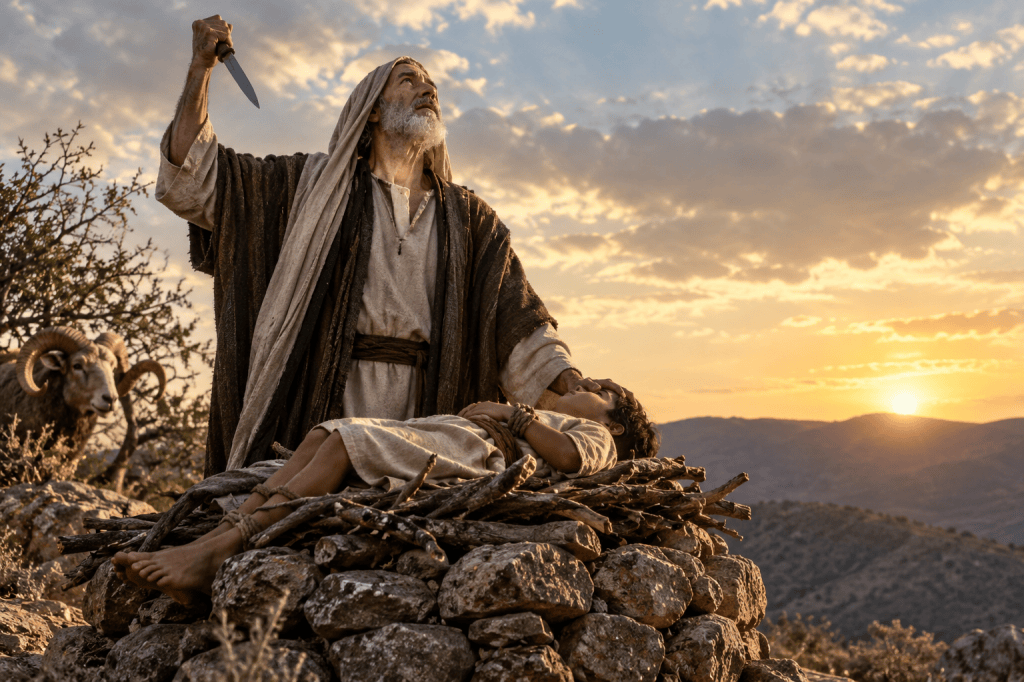
Abraham was tried by God and commanded to offer Isaac, his only begotten son—the very son concerning whom God had said, “That in Isaac shall thy seed be called.” Isaac was not merely someone Abraham loved; Isaac carried the promise. Abraham had waited for him, received him by the faithfulness of God, and knew that God had specifically tied His promise concerning his seed to this son. Yet the same God who gave Isaac now commanded Abraham to offer him. From the natural perspective, the command appeared to stand against the promise. If Isaac died, how would the promise concerning Isaac be fulfilled?
Hebrews tells us what happened in Abraham’s heart: he accounted that God was able to raise him from the dead. The word translated “accounting” is the Greek logizomai—to reckon, consider, calculate, take into account, or arrive at a conclusion through reasoning. Abraham did not obey because he had ceased to think. He thought about the promise. He considered the command. He considered how Isaac had been given to him in the first place, and he calculated what God was capable of doing. His conclusion was that if God gave life, then God was also able to restore life. If God said the promise would come through Isaac, then even death could not make the promise of God impossible.
This teaches us something important about biblical faith. Christian faith does not forbid logic and reasoning, it teaches us how to reason with God included in the calculation. Abraham’s reasoning did not lead him away from obedience but brought him to the conclusion that obedience was still the best possible response because the power of God was greater than the consequence he feared. He did not know that there would be a ram caught in the thicket. He did not know exactly how God would intervene. What he knew was that God had spoken concerning Isaac, and therefore, even if obedience took Isaac all the way to death, God was able to raise him again.
Sometimes we imagine that genuine faith means never having questions, never considering consequences, or never recognizing what obedience may cost us. Yet Jesus Himself told those who desired to follow Him to count the cost. In Luke 14:25–33, He speaks of a man intending to build a tower who first sits down and calculates whether he has sufficient resources to finish it. Christ did not invite people into discipleship through ignorance of its cost. He told them to consider what following Him required and then make the decision to follow. There is a kind of faith that has calculated the sacrifice, understood what may be lost, recognized the consequences, and still says, “Yes, Lord.”
It is this kind of faith that euaresteōs the Father. Faith does not necessarily mean that you cannot have fears or questions. It does not mean that you cannot consider the possible outcomes or desire another way. Abraham himself had previously reasoned with God concerning His purposes, yet when the moment of obedience came, his reasoning ultimately rested upon the character and power of God. Faith may count the cost, but after counting the cost, it chooses to trust that God remains greater than whatever obedience may cost.
Perhaps the problem with many of our calculations is not that we calculate too much, but that we stop the calculation before we include God. We calculate our resources. We calculate the risk. We calculate what we may lose. We calculate the probability of success. We calculate our weaknesses, the opposition, the timing, and every possible outcome—and then conclude that obedience is impossible. Abraham calculated all of these things and then added something else to the equation: God is able to raise the dead. Once the power of God entered his calculation, what appeared to be the end was no longer necessarily the end.
This week, calculate! Count the cost. Consider the consequences. Acknowledge what you fear. Understand what obedience may require from you. But do not leave God out of your calculation. Do not calculate the cost of obedience without calculating the power of the One commanding you. Do not calculate what you may lose without remembering the One who gave it. Do not calculate the impossibility of your circumstances without remembering that resurrection belongs to God. Abraham did not know how God would resolve the apparent contradiction between the command and the promise, but he knew enough about God to obey Him.
Faith is not the absence of reasoning. It is reasoning that ultimately arrives at confidence in God. After you have counted everything, may your final calculation still be: God is able!
Further reading: Genesis 22:1–18, Hebrews 11:1–6, 17–19, Luke 14:25–33, Romans 4:17–21


Leave a comment