
||Rhema for the Week||
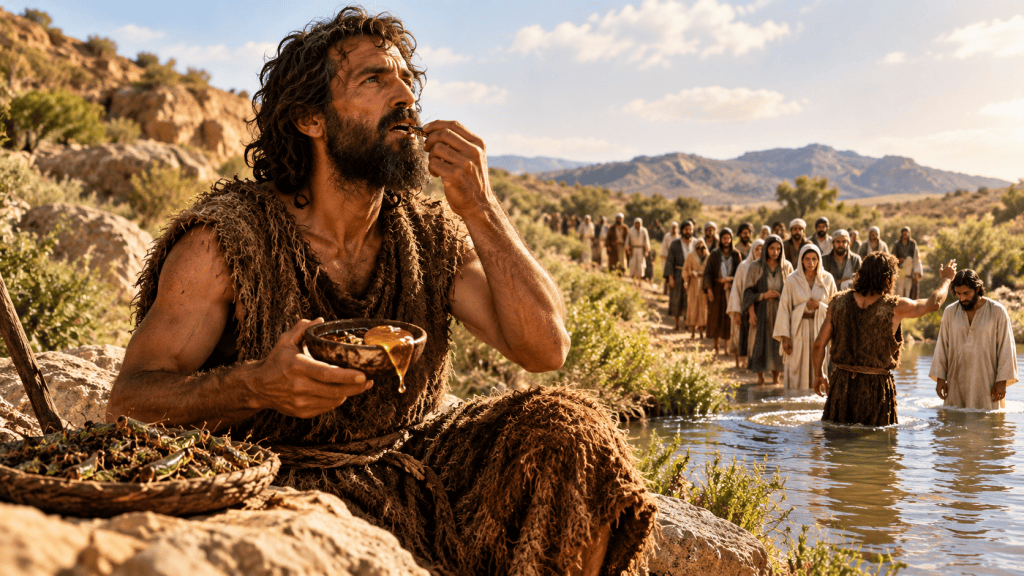
“Now John himself had a garment of camel’s hair and a leather belt around his waist; and his food was locust and wild honey” — Matthew 3:4
Throughout Scripture, God reveals Himself as a faithful Provider. He sent ravens to feed Elijah during famine, provided manna for Israel in the wilderness, multiplied a widow’s oil through Elisha, and fed thousands with five loaves and two fish. Yet one story of that always stands out to me anytime I think about God’s provision is that of John the Baptist. The New Testament reveals that he was the forerunner of Jesus Christ, sent to prepare the way of the Lord. Jesus would later describe him as more than a prophet and declare that among those born of women, none had arisen greater than John the Baptist (Matthew 11:9–11). At this point, you can agree with me that John was indeed no ordinary man.
Yet, the environment in which John fulfilled this significant calling was hardly comfortable. Matthew tells us that John lived and ministered in the wilderness, clothed himself in camel’s hair, and ate locusts and wild honey (Matthew 3:1–4). His provision immediately appears quite unusual but what he needed to sustain his assignment was available. This reminds us that God’s provision does not always look like abundance, comfort or long-term security. Sometimes, provision is simply God ensuring that what we need is available where He has called us to be. Jesus illustrated this when He reminded His disciples of the time He sent them out without a money bag, knapsack, or sandals and then asked, “Did you lack anything?” Their answer was, “Nothing” (Luke 22:35). They did not begin the journey possessing everything they might need, yet as they went where Christ sent them, their needs were met.
Perhaps this is one of the difficult lessons of walking by faith: we sometimes want to see the provision before accepting the assignment, while God may allow us to discover the provision along the way. For John, locusts were literal food and were permissible under Jewish dietary law (Leviticus 11:22). But your “locusts and wild honey” will probably NOT be literal. They may be the scholarship that makes your education possible, the person who recommends you for an opportunity, the small income that sustains you while building something greater, the unexpected connection that opens a door, or the grace and strength to thrive a demanding season. Have you been rejecting God’s provision this year because it arrived in the form you did not imagine?
As young people pursuing education, careers, ministry, relationships, and God-given dreams, we often want certainty before obedience. How will I pay for it? Where will the opportunity come from? What if I leave what is familiar and things do not work out? How will I sustain what God is asking me to begin? These are indeed legitimate questions, but they must not become masters over our obedience. Jesus teaches us to pray, “Give us this day our daily bread”. Yet many of us want annual bread. We want to know today how God will provide for the next twelve months before taking the next step of faith. But Jesus also reminds us not to become consumed by tomorrow, because tomorrow will have its own concerns. Sometimes God gives us long-term security; sometimes He provides enough light and resources for the next step and asks us to trust Him for the one after that.
John’s wilderness therefore teaches us something profound: an uncomfortable place is not necessarily an unprovided-for place. The wilderness did not become a palace, but John was sustained there. God did not have to change the environment before John could fulfill his assignment.
Perhaps, as you read this rhema for the week, you are in your own wilderness season. It appears resources are limited and the future of the remaining months in 2026 appear uncertain. It could even be that what you have does not resemble what you expected. I encourage you to look again. Your provision may already be present but only in an unfamiliar form.
As we begin the final quarter of 2026, I encourage you not to measure God’s provision only by excess. Sometimes the testimony is simply: “I had what I needed, when I needed it, to do what God called me to do.”
What does God’s provision look like in your present season? Are you overlooking your “locusts and wild honey” because you are waiting for provision to appear in another form?
Further reading: Luke 1:76–80, Matthew 3:1–4, 6:11, 25–34, 11:9–11, Mark 1:4–6, Philippians 4:19, Exodus 16:4–15, 2 Kings 4:1–7


Leave a Reply